
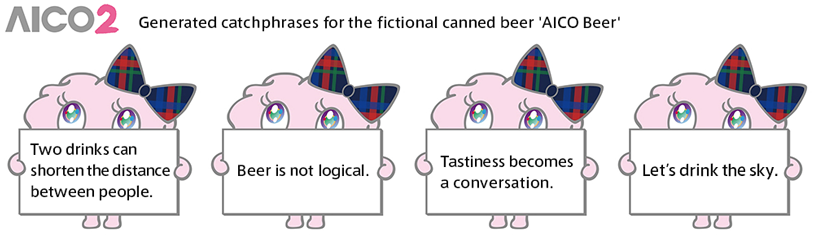
Can AI replace jobs that require creativity, where humans should be able to demonstrate their true worth?
Dentsu’s AICO2 is the world’s only AI copywriter equipped with a creative thinking model*1. Humans will discuss the essence of creativity from various angles based on the copy that AICO2 creates.
In this article, we will join Naoki Tanaka (Dentsu Lab Tokyo), an executive creative director/copywriter who specializes in combining technology and creativity, Hiroki Kita, the AICO2 project leader, and Dai Hirose, who was involved in the project’s development from a creative perspective, as they discuss AICO2’s current capabilities and the future of the work that copywriters do!
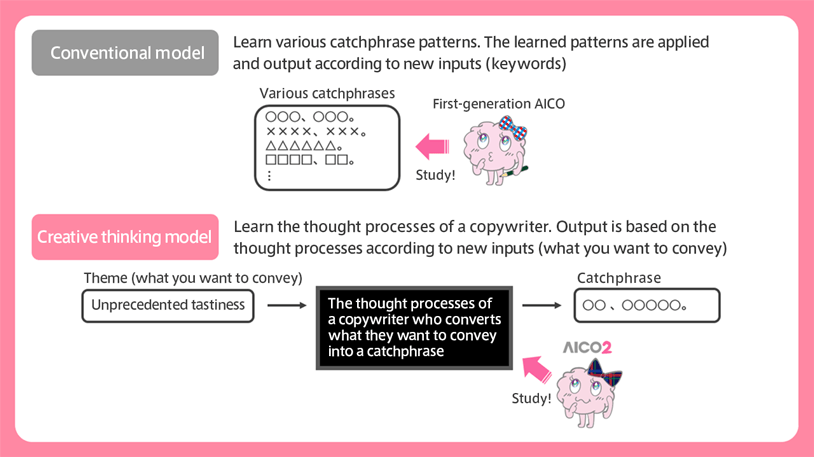
| *1 | Creative thinking model: The original AICO learned copy thought up by copywriters, but AICO2 also learns the intentions and thought processes of creatives, which dentsu calls the creative thinking model. |
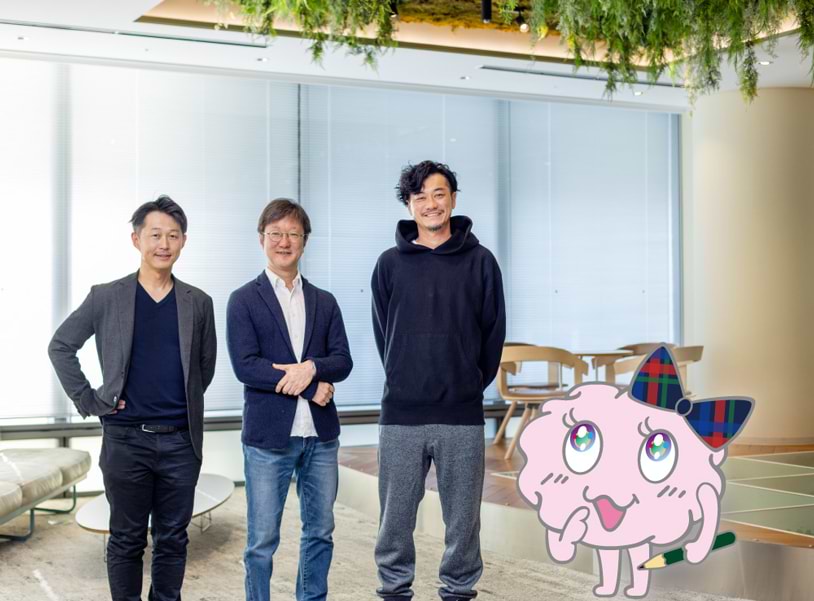
Chief Creative Officer, Dentsu Lab
Naoki specializes in the neutral planning of copy, video, technology, content development and so forth, using the appropriate methods for the task. He has received numerous awards, including Cannes Lions, D&AD, ADFEST, Spikes Asia, an ACC Award, a TCC Newcomer Award, and a Good Design Award.
Dai specializes in product naming and concept development for companies such as Satofull Co., Ltd. and products such as “Choi Mac” (smaller-sized affordable menu items) for McDonald’s, and is currently using his advertising creative skills in the BX domain, working on corporate music video visuals (MVVs), developing concepts and names for new products, and writing speeches for management.
After working as a copywriter and account executive, and being seconded to Beacon Comand being seconded to Beacon Communications, Hiroki was involved in drafting numerous product advertising plans. Later, as the advertiser representative for a television program sponsored by one company, he was in charge of the launch of multiple new programs with broadcasting stations. He is currently involved in data-based customer analysis and planning, as well as the development of the target profiling tool People Profiler and AICO2.
Development began with a discussion between creatives and AI engineers
Hirose: This time, we have invited Naoki Tanaka to speak on the theme of creativity and technology, but before that I would like to ask Mr. Kita from Marketing Division, who is the project leader of AICO2, to tell us about the background to the creation of AICO2.
Tanaka: Oh, before we get to that, I should note at the outset that this conversation took place in early December, 2024. This field is evolving at a really fast pace.
Kita: That’s true. Before you know it, it will be a thing of the past.
Hirose: Let’s hear from Mr. Kita, who took on the development of AICO2 in a field that is moving at such a rapid pace. Mr. Kita developed AICO2 because he found it troublesome to ask self-centered copywriters to develop copy for him as part of their daily work.
Kita: No, let’s put that aside for now... The first AICO was released in 2017. At that time I was shocked by how AICO was able to spin words that humans could never have imagined. According to the development team behind the first-generation version, they single-mindedly created a database of a huge amount of copy and based it on the patterns learned. Meanwhile, in 2023, six years after the birth of AICO, generative AI based on large-scale language models (LLMs) are appearing one after another, and the impetus for the development of AICO2 was to see what would happen if AICO was updated based on LLMs. In that sense, AICO2 has a different base platform from the first generation.
Related series: AI-driven serendipity (in Japanese only)
Tanaka: So the internal model is different from the first-generation AICO?
Kita: Yes, I was originally a user of the first-generation AICO, and had high hopes for the AI copywriter. However, the AICO project leader Hiroyuki Fukuda (currently the CEO of Chanfuku Inc.), went independent and started his own company, and the project was temporarily put into a rebuilding phase.
Meanwhile, I was working on a target user analysis tool with a team of AI engineers from Dentsu Digital, a project unrelated to AICO. Then the engineers on that team said, “You can now reboot AICO using ChatGPT,” and so I decided to take the lead in developing AICO2.
The first-generation AICO had various catchphrase patterns as the AI learning targets, but AICO2 was trained on “The thought processes of dentsu copywriters,” and Dentsu Digital’s AI engineering team performed fine-tuning*2 based on ChatGPT 3.5.
| *2 | Fine-tuning: A method of making adjustments to an existing trained model to make it more specialized for a specific task. |
Hirose: However, at first, there were no creative members on the development team.
Kita: Yes, it was just me and a team of AI engineers, and although AICO2 did take shape, in terms of creative quality it was not something that dentsu could present to the public. At that time, the executive in charge of creativity said to us, “We can’t release it in its current form, but we’ll add some creatives to the team, so please remake it.” So, six creatives, including Mr. Hirose, ended up joining the development team.
Tanaka: Frontline copywriters. That’s great.
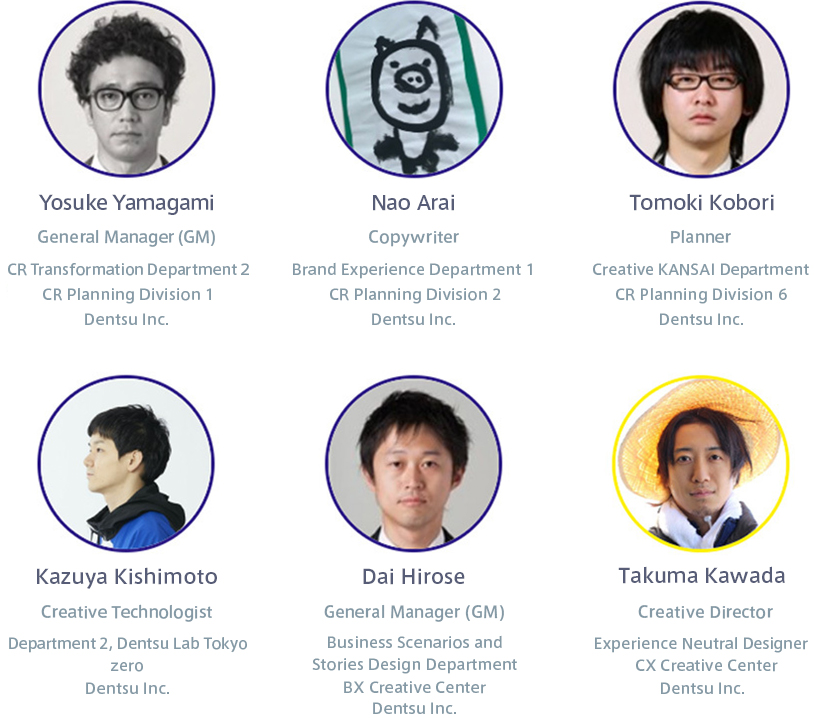
| Note: | Affiliations and titles were current as of the time of development. |
Hirose: However, even though we were invited to participate, we thought, “There’s no way we can lose to an AI,” but at the same time we thought that it would be interesting if we could create something amazing.
Kita: At first, the atmosphere was pretty stiff.
Hirose: As I said earlier, Mr. Kita, it seems that you were trying to create an AI copywriter because you’re not good at working with creatives (laughs). I remember thinking when I heard that story that it was a good, human-like reason to develop AI.
Kita: When they met for the first time, the AI engineers asked the six creatives a lot of questions, such as “What’s the thought process behind creating copy?”
Hirose: During our first meeting, I thought that even though Mr. Kita and the other AI engineers seemed to understand how copywriters write copy, they still didn’t really understand it fully. It’s the same as us not knowing what kind of thought processes AI engineers use to create AI. I have been providing copywriting training for new creative employees for nearly 10 years, and I proposed to my team that we have our engineers take the first and second sessions of that training. I thought that that would be the quickest way to help them understand, “Oh, so this is the thought process that goes into copywriting,” and for them to get a more concrete image of that process.
Tanaka: That’s interesting!
Kita: That copywriting training with Mr. Hirose was a turning point in the development of AICO2. It was a real eye-opener for me. The copywriters I’ve worked with until now gave me the impression that they wrote copy based solely on their intuition. However, Mr. Hirose’s talk was extremely theoretical and systematic, and I thought, “Wow, I can understand this!”
Tanaka: I see. This is especially true for me, but copywriting is mostly about logic. People sometimes have the impression that it’s something you do with intuition and genius.
Kita: After the engineering team completed the two training sessions, they said they wanted to create a dataset so that the AI could understand that logic. In order to do that, they gave the six creatives some “homework.” The details of that homework are a trade secret, though.
Tanaka: I see. It’s amazing that the engineers were able to understand that structure after just two classes and then give out homework. What kind of homework was it?
Hirose: Well, you see…. (secret conversation).
Tanaka: This is…such a pain! (laughs). You have to write it in that format.
Hirose: It was a pain, wasn’t it? We had to write more than 100 of them.
Tanaka: That must be such hard work that you’d have to pay lot of money for.
Hirose: However, the copy that we submitted as homework for the AI to learn from wasn’t all copy that we had written in the past. Dentsu has a large collection of “copy that is legal to use as long as you get permission from the person in question,” and so the six of us divided up the work and submitted the “homework” to the engineering team.
Tanaka: Ah, I see. Even if you didn’t write the copy yourself, analyzing it in this format can certainly make it easier to understand. It’s a bit tedious, but interesting. It’s essentially a re-experience. I think it’s a good way to break it down for people who are studying copywriting. I also give lectures at companies such as Sendenkaigi (a Japanese media company specializing in marketing communications), and this is similar to what I have my students do there.
Kita: By creating a dataset as homework, what did we make the AI learn? AICO2 is designed to learn “Why” rather than learning copy as a goal. For example, in the case of Mr. Hirose, the idea is to imitate the thought processes in Mr. Hirose’s head.
After the development process had progressed to a certain extent, the engineers printed out around 300 copies as a test, and the six creatives were excited from the very first shot, saying things like, “This is different from before!” and “This might be good.” And so, as development progressed, the output improved.
Copy is an “unnatural language model.” Is it actually incompatible with natural language processing?
Tanaka: So you created your own dataset for learning the copywriting process.
Hirose: However, it seems that it’s not as simple as just increasing the number of things that are learned to improve the quality.
Kita: Whether it’s ChatGPT or Google Gemini, the so-called LLMs are basically natural language processing models. In other words, they are models for generating easy-to-understand, natural Japanese phrases, but there’s a problem here. The catchphrases written by copywriters don’t actually use natural language.
Tanaka: That’s right. It’s more of an “unnatural language.” That was exactly what I was most interested in before coming here today. You’re using ChatGPT, right? I thought it might not be compatible with writing copy. In other words, I thought “normal words” would come out. The interesting thing about copy is that it moves people’s hearts and minds the most when it’s missing some necessary words, or when it’s rough, or when it uses words that the recipient never imagined. If you were to do that with AI, I feel like it would have to undergo some pretty specialized learning.
Kita: It’s true that when the copy moves you a little or catches your attention, it’s not “natural”…
Kita: Actually, I originally developed it with the idea that it would be great if we could output copy without assigning a human copywriter.
Hirose: Oh, you are so honest! (laughs)
Kita: So, I initially thought of it as something that would be used by non-creatives.
Tanaka: Yes, I think that’s where the current need for AI copywriters lies. For example, I thought that there was a need for them among salespeople, or among small and medium-sized businesses and stores that don’t have their own in-house copywriters.
Kita: But after completing it, I realized that choosing the best copy from among those written by AICO requires professional skill. It might become possible once you get used to it, but it takes time. When I think about how AI copywriters can be used, there are two ways. One is to have an AI copywriter act as an assistant to a copywriter, and the other is to have the AI write copy like a creative director, and have humans focus on selecting from that copy.
Tanaka: I think it will be possible in the future, and I hope that it does become possible. The current AICO2 may require a bit more training (laughs). But I think the current AICO2 can also be put to immediate use. For example, there seems to be a huge need for people who want to add copy to posters like this one, but don’t have the resources or budget to hire a copywriter. For this purpose it is already at a practical level.
Hirose: If you were to use AICO2 for work, Mr. Tanaka, how would you use it at this point? Please give us your honest opinion.
Tanaka: Well, when I actually tried using it, I did discover new perspectives and approaches. I was able to find things like, “Oh, I hadn’t thought of that perspective before,” or “Maybe I could have looked at it this way,” but I just want to increase what we call the random occurrence rate of these things. If the rate at which these discoveries occur increases, we may see a time when AICO2 can be used as an assistant to write copy.
Hirose: By the way, how can we increase that random occurrence rate? I’ve been wondering how we intentionally create what we call a creative jump. I feel like this is connected to that.
Tanaka: That’s difficult. When writing copy, the most important thing is to discover “Oh, there was another perspective.” This is what we call “What to Say,” but I think the first step in writing good copy is to present a new discovery when looking at a certain product or targeting the people who use that product, such as “This is what was thought up to now, but in fact there is another way to look at it.” And it’s difficult to come up with copy with that aim in mind.
Kita: My AI engineers and I were originally researching how to analyze the “target demographic” of marketing. Perhaps by adding a “who” element, such as “Who is the copy targeting?” or “Who do you want it to reach?” you may be able to increase the random occurrence rate.
Hirose: I see. That’s interesting. However, I have the opposite opinion. It’s true that there is a theory about targets, but when I look back at the work I’ve done so far, when I’ve written copy that I think is good, I haven’t really written it in terms of how to speak to the target audience. Actually, if anything, it happens when I’ve found something that I really wanted to say. I feel the most moved, or I think, “This is what I really wanted to say to the world.”
Tanaka: I understand. When I came up with the copy “People need eateries.” rather than targeting a specific audience, I felt like “This is what I wanted to say most,” or “I wanted to express my gratitude to restaurants myself.”
Hirose: Isn’t that so? So unless the AI has some vague, passionate feeling inside of it that makes it think, “Actually, this is what I wanted to say,” I think it will be difficult to write copy at the level that Mr. Tanaka is looking for.
Tanaka: What makes this discussion even more difficult is that even highly experienced copywriters can clash head-on over what they think is good and what they think is not. This often happens when judging advertising awards. After all, each writer has different values and perspectives that they want to emphasize, which may make development all the more difficult. In that sense, it’s difficult for AI to become everyone’s partner, so I think it would be best if it were customized for each copywriter.
Hirose: Ah, I see. The more you maintain it, the more it becomes “your” companion. Your thought processes build up, and the AI starts to take on a personality.
Tanaka: Yes. For example, Mr. Hirose could have his partner “DAICO” and I could have “NAOCO” (laughs). If that were to happen, I think it would be a service that copywriters would find even more useful.
Kita: Hearing that flipped a switch for me (laughs). I want to update AICO2 to something that professionals like Messrs Tanaka and Hirose feel they will be able to use. As Mr. Tanaka said earlier, the use cases for non-creatives are exactly what we were aiming for, so it’s a nice compliment to hear that there is a need. I’d like to impress more professionals and have them say “Wow, this newcomer is amazing.”
Copywriters will never become extinct, but I would like to see AICO evolve to that extent!
Tanaka: I’d like to go back to the topic of occurrence rate for a moment. There’s something I feel when using AICO2. I like to categorize things logically, so when I categorize copy, there’s one zone where it’s something that “Everyone already knows” or “It’s so obvious that it’s not really a suggestion.” There is another zone when something is so far ahead of its time that it’s hard to understand, and you think, “That’s just your own idea,” or “That’s self-centered.” Good copy is somewhere in between these zones. In other words, it makes you think, “Now that you mention it, that makes sense,” or “I hadn’t noticed it before, but that might be true,” and it flips the empathy switch and moves your heart.
Hirose: We would like to increase the occurrence rate of that zone even more.
Tanaka: That’s right. AI uses data from “a little while ago,” so it tends to fall into the “I’ve seen this before” or “Someone already said that” zone. What’s even more difficult is that once someone discovers something and describes it as “new,” it quickly falls into the “I’ve seen this before” zone once it becomes established in society. If AICO2 becomes able to control this and is able to say, “This is a perspective that not many people know about,” then the theory that its existence will become dangerous for copywriters will start to emerge.
Hirose: Apparently the theme of this article is “Will AI make copywriters extinct?” (laughs). The greatest advantage humans have when it comes to creating such “new things” is that they have bodies. No matter how far AI goes, it is input with “past information” and creates from that, whereas humans live their lives feeling various things in the moment with their bodies, and so there is a lot of input from that.
Tanaka: That’s true. Current AI converts input into something that can be treated as data, but humans write copy by simply taking in all sorts of information, such as the smell of the place, the temperature that day, or even the “awkwardness” they feel.
Hirose: If that were to happen, human copywriters would no longer become extinct, but I’d like to evolve it to the point of extinction if possible (laughs).
Tanaka: In terms of whether it’s possible, I think it will be possible someday. I believe the key is the “unnatural language model.”
Hirose: On the other hand, AI has its strengths too.
Kita: If there are multiple thought processes, AI is unique in being able to output each one. Humans tend to get carried away with their own way of doing things, so they can only do two or three of them. Other human weaknesses are that we get tired easily and take a long time to do things. So if the ideal situation is to produce countless outputs in a short amount of time, leading to new discoveries, then the current theme is to increase the rate at which discoveries occur.
Tanaka: What I find really interesting about creating AICO2 in this way is that the way copywriters think is still largely a black box. I think some of the things that have become clearer in today’s discussion are that the development of AICO2 is akin to the process of endlessly analyzing “copy,” or more specifically, how to “move people’s hearts with words.” On a similar note, Professor Hiroshi Ishiguro said that the reason he creates androids is “to understand humans.”
Hirose: That is the Professor Ishiguro who created “Matsukoroid*3”, right?
| *3 | Matsukoroid is a life-size humanoid robot modeled on Matsuko Deluxe, a Japanese columnist, essayist, and plus-sized cross-dressing TV personality. It was created by Professor Ishiguro in 2015. |
Tanaka: Exactly. It’s the same thing. I thought that the very attempt to recreate the way copywriters think with AICO is itself an act of loving copy even more, and that thinking about AICO might make copy even more interesting. That’s why I think this initiative is really interesting.
Copywriters have to keep on trying new things. Even copy that is “unnatural but interesting” will become established and “natural” after a few days. From an AI perspective, the correct answer continues to elude us.
Kita: It’s interesting that there is no correct answer, and that even though it’s logical, there is single correct answer. A Hirose-type AICO and a Tanaka-type AICO are also completely acceptable. Is there anything you would like to see done differently with AICO2?
Tanaka: I’d like it to support voice input. When I’m writing a plan or copy, I don’t want to touch anything other than a pencil and paper. So, having to open my PC every time and type into AICO2 is stressful, and I just freeze up. In fact, if the system could use voice recognition to learn from the copywriters’ discussions, we wouldn’t have to input our homework every time.
Hirose: That’s amazing! It can learn and grow on its own by listening to human conversations.
Tanaka: There may still be many aspects that human copywriters have not yet been made aware of or turned into data.
Hirose: While doing my homework this time, I realized that one of dentsu’s assets that is not often recognized is the quantity and quality of the plans that its creative staff have come up with until now. That’s for sure. If you want to create an AI copywriter, this may be the biggest barrier to entry.
Tanaka: It seems like no one else is really tackling this field, so we’d like to do our best.
Kita: There is currently no other company in the advertising field that undertakes projects with such a large number of people and on such a large scale. Only dentsu could train AI to learn the thought processes of those people. AICO is still in the development stage, but as we have received so many hints today, we would like to continue improving it. Thank you for your time today!
Please also see here for details on the history and content of AICO2
https://www.dentsu.co.jp/en/showcase/aico2.html
Related Link
Will AI make copywriters extinct? (Japanese language only)


