
“We are working on biodiversity conservation, but it hasn’t translated into corporate value.”
“We are being asked about the return on investment of our long-standing environmental activities, and how they are linked to our business.”
In Japan, biodiversity came to the forefront as a social issue around the time of Expo 2005 Aichi, and many companies around the world have been continuing biodiversity-related activities for many years. However, the nature conservation activities that were pioneered around the world no longer necessarily provide a competitive advantage, and with demands for cost cutting, it may become difficult to continue them. The reality is that many companies face the same concerns as those mentioned at the beginning of this article, such as finding it difficult to explain when asked why they have continued doing the same thing for so many years.
Furthermore, in Japan, some major companies will be required to disclose sustainability information in their securities reports starting from the fiscal year ending March 2027, with the number of applicable companies expected to increase gradually. How should companies approach biodiversity conservation and demonstrate their corporate value?
In this article, we interviewed Asako Nagano, a forestry consultant at MORI-AGE, Inc., which aims to revitalize Japan’s forests and pass them on to the next generation, and Yuka Sawai from Dentsu Inc.’s Sustainability Consulting Office. We discussed the current state of nature conservation activities undertaken by companies, the challenges they face, and the ways to turn these activities into a company’s strengths.

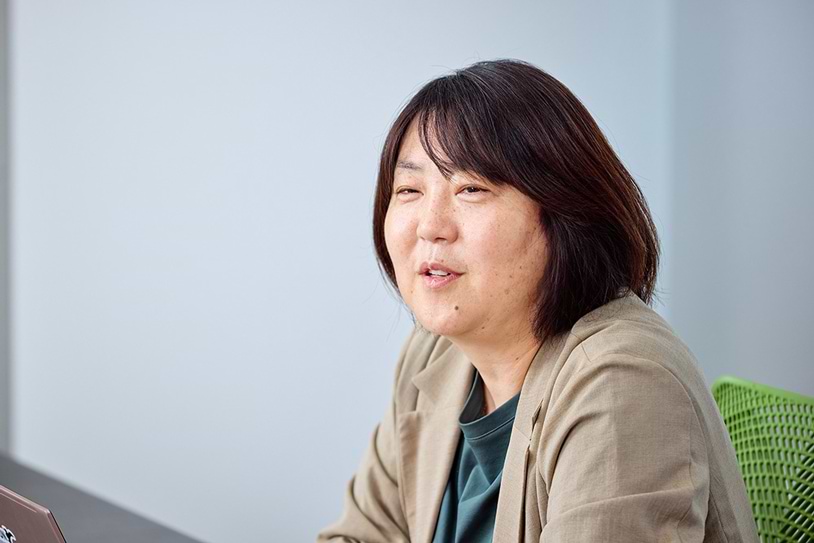
The two are striking the “moriage” (boost) pose to boost and revitalize Japan’s forests
Japan boasts the third highest forest coverage rate among developed countries. What is the relationship between “biodiversity” and “forests”?
—First, please tell us how “biodiversity” and “forests” are related.
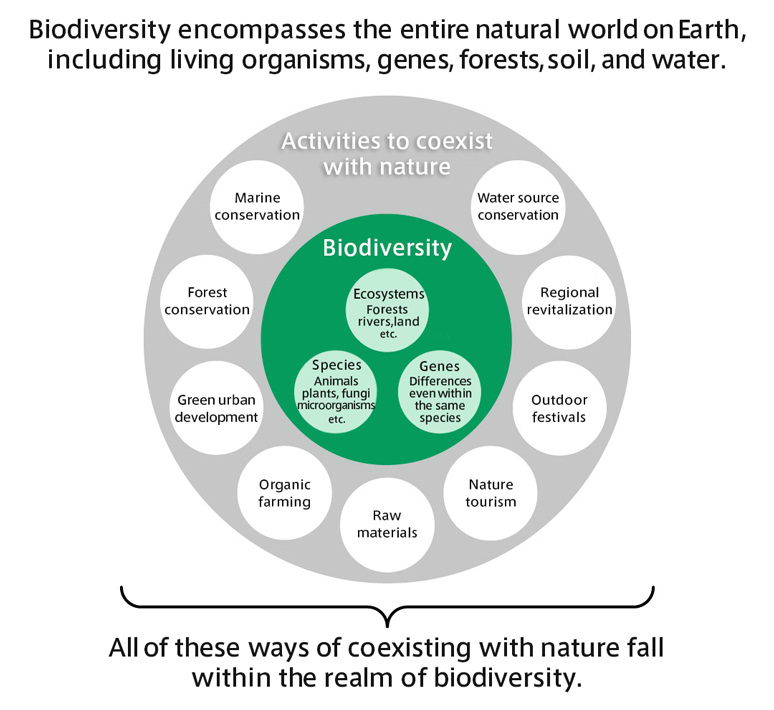
Sawai: First of all, I would like to say that biodiversity does not just refer to the species of living things, but also includes the entire natural world on Earth, including ecosystems such as forests and satoyama (traditional Japanese rural areas where people coexist sustainably with nature), and even genes. Activities that allow us to coexist with nature are at the core of thinking about biodiversity. We receive many blessings from nature, and conserving biodiversity is also an effort to create a future in which we can live in harmony with nature.
Forests are one such example. Not only do they protect plants and animals, but their ability to store water also contributes to the conservation of water resources. Water is an essential resource for all human beings and many industries, so protecting water sources can be said to be a practical example of “symbiosis,” which is a foundation of business. Furthermore, many of the nature symbiosis sites certified by the Ministry of the Environment are related to forests.
Nagano: Approximately 70% of Japan’s land area is covered by forests, making Japan the third most forested country among developed countries (OECD member countries) after Finland and Sweden. No other country with such a large population and economy is able to maintain its forests.
—How are companies that conserve forests viewed?
Sawai: Of course, we receive requests from investors as well as organizations and experts involved in environmental conservation, but recently corporate forest conservation activities have also been attracting attention as a way to foster empathy and engagement.
Nagano: Some companies say, “We continue with our forest conservation activities because our young employees take pride in them.”
Sawai: The term “natural surroundings” is being used on social media among young people, reflecting the growing attitude of valuing nature and spending time relaxing in nature. I get the impression that there are more and more cases where these values overlap with corporate initiatives.
Nagano: Human resources are an asset for a company, and initiatives such as mental health measures that utilize forests to promote wellbeing are also effective. In Germany, doctors sometimes prescribe employees to “go to the forest for a week,” and health insurance sometimes covers this. It is truly a “forest prescription.”
Not only TNFD information disclosure but also the quality of actions is being questioned
—What trends are there in corporate initiatives regarding biodiversity?
Sawai: Last year, we received many inquiries from companies about the Taskforce on Nature-related Financial Disclosures (TNFD)*, but this year, we are hearing more and more people say, “We have started responding to the TNFD, but we don’t know what will be required of us from now on.” Each company is working on the TNFD itself, and it is quite difficult to show originality through that alone. That is why we recommend demonstrating it through “actions” that are unique to that company.
| *TNFD (Taskforce on Nature-related Financial Disclosures) |
| A framework for companies and organizations to assess and disclose the impact of their economic activities on the natural environment and biodiversity |

Nagano: Since eighty percent of terrestrial creatures live in forests, forest conservation can contribute to nature positivity. I am currently researching how companies can link their forest conservation activities to corporate value. In fact I would like to create value together with companies.
Sawai: Some companies continue forestry activities as an extension of their CSR activities, but in many cases they are unable to effectively articulate their value and significance. While some say, “It is not linked to the company’s value, but it is hard to quit because of the public image,” the accumulation of these efforts is an irreplaceable and valuable asset. Now that biodiversity is in high demand, perhaps this is an opportunity to reconsider these activities as an investment in corporate value and the future.
Nagano: In fact, corporate forest ownership also saw a boom in the 1990s. I feel that a second boom is currently underway. However, we must not let this boom end there, because forests will endure across generations.
At MORI-AGE, we advocate “one company, one mountain,” and encourage each company to take a long-term interest in forests as their own business. We believe that such ongoing involvement leads to corporate value.
Sawai: It is also important to be able to explain the value of these initiatives in your own words.
Nagano: Recent advancements in measurement technology and simulation accuracy have made it possible to quantify the effects of forest conservation. By demonstrating the effects of water source conservation and soil erosion prevention in numerical terms, a company’s initiatives will likely be evaluated more favorably.
Five perspectives for turning nature conservation initiatives into corporate strengths
—Could you explain the “Five perspectives for demonstrating nature conservation initiatives as corporate values” developed by Dentsu Inc.?
Sawai: Biodiversity situations vary from region to region, so it is essential to logically communicate the story of “why that region” and “what is the motivation behind the initiative?” The following outlines perspectives on how to convey this. I would love to hear your thoughts on this, Ms. Nagano.
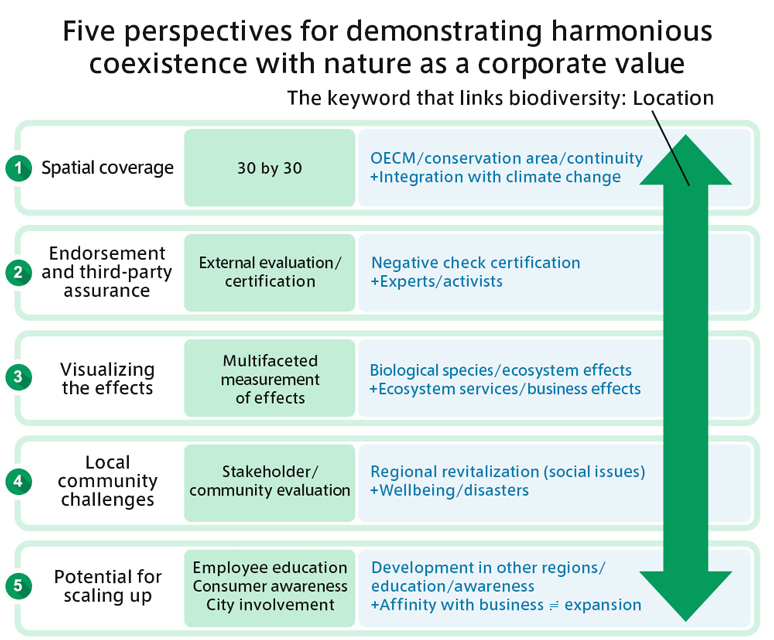
Sawai: The first point is “Area.” From the perspective of 30 by 30 (the goal of conserving at least 30% of land and sea as healthy ecosystems by 2030), it is important to indicate the area of conservation. In addition to the status of registration of nature symbiosis sites, if information is also provided on their compliance with OECM (a framework that internationally certifies conservation activities by the private sector and local communities), which is highly regarded internationally, it will enhance the credibility of the information. Furthermore, it would be best if it could be linked to climate change.
The second is “Official endorsement.” It is essential to have experts who can evaluate and support a company’s conservation activities. Collaborating with experts such as Ms. Nagano also increases the resolution of the activities.
Nagano: However, I feel that caution is needed regarding an “official endorsement.” I understand the desire to obtain external evaluation and certification, but it can often be very costly and time-consuming.
I don’t recommend starting with an “official endorsement.” I think it is more meaningful to first support people who are engaged in nature observation in the area, and to collaborate with local universities and organizations, thereby deepening knowledge together with the local community. I believe that it is important to build up practical experience in the community without relying on certification.
Sawai: That’s true. I am sure there are people other than experts who have knowledge of the biodiversity of each region, so it might be a good idea to start by asking the opinions of people who are familiar with the area.
The third point is “Visualizing the effects.” It is necessary to communicate to society not only the increase or decrease in biological species, but also the multifaceted effects of conservation, such as disaster prevention and heat island mitigation. This is because that simply saying “forests are wonderful” won’t get the message across.
Nagano: By visualizing the effects, I think that even local people who take forests for granted will be able to rediscover the treasures that lie in a forest through a company’s communication. I hope that this kind of exchange of values will come about.
Sawai: The fourth is “Regional issues.” This is the perspective of joining forces with the local community to link conservation efforts to solving their specific issues.
Nagano: There are differences between the issues that local residents are aware of and the issues that are seen from the outside, so it would be meaningful to work on them while exchanging perspectives. As local governments work on urban development while involving residents, adding a corporate perspective to forest conservation could lead to some interesting developments.
Sawai: I believe that if we can build a “triple win” relationship in which companies, local communities, and biodiversity mutually support each other, our activities will be sustainable.
And finally, the fifth point is “Expansion.” If the first four elements are thoroughly implemented, the initiative should be able to be expanded to other locations.
Lateral expansion of successful examples, when combined with the unique characteristics of a region, can lead to unique activities
—Are there any examples of activities that you have been involved in, Ms. Nagano, that fit the description of “expansion”?
Nagano: Minakami Town in Gunma Prefecture has been working to create forests to protect golden eagles for more than 20 years. The creation of hunting grounds and forest regeneration has led to the successful breeding of golden eagles. As a lateral expansion of this initiative, starting this year we plan to work with the local community in Kaneyama Town in Yamagata Prefecture to create new value.
Even if the theme is the same, if the location is different it will become something unique to that place. This is why it is important to create a plan through dialogue with the local community, rather than simply imposing the company’s own ideas. If you can learn from the local community how to find value and have an attitude of respect for its history and culture, I think you can continue to be involved without any difficulty.
Sawai: When it comes to biodiversity conservation, the perspective of location—where to work—is very important. In fact, the first step in TNFD is “Locate.”
Identifying a location means deeply connecting with the natural environment and culture rooted in that land. It could be said that the local community is the biggest stakeholder. When the essence of the region and the essence of the company overlap, a unique story is born, and the initiative becomes even more appealing.
—Finally, I would like to ask: What is the appeal of forests for you both?
Nagano: In fact, going to the forest feels overwhelmingly good. I think that is because humans were born from the forest and have an instinct to return to nature. Even if you are not interested in forests, I would like you to try going to one at least once, even if you think you have been tricked (laughs).
This also relates to the idea of biodiversity, but humans are also part of nature. I feel that by observing and interacting with nature, people can regain their sense of humanity. Nature and wellbeing are surely inseparable.
Sawai: I love camping, and spend most weekends in the forest (laughs). After talking about those five perspectives, I think it is really important to have that honest feeling that “forests are wonderful.” Of course, it is necessary to build up a logical justification for the importance of biodiversity, but people won’t act on logic alone.
Even if only a little interest in forests sprouts in the world, the actions that follow will help protect biodiversity. The moment our hearts are moved by the forest, it acts as a switch for biodiversity. I believe it is that kind of sensory experience that will help us understand the essential importance of nature and enrich our future.
—Thank you for your valuable insights today