
Dentsu Youth Research Lab (hereafter “Dentsu Wakamon”) conducted a large-scale survey for the first time in two years, targeting high school students, university students, and early-career professionals (in their first three years in the workforce). Based on the results, we created “Youth Insights in Japan 2025” a resource that explores young people’s values today. (Click here for inquiries about the survey).
This article introduces the key findings from the survey.
Young people unable to articulate their true feelings: Behavioral values that seek to avoid “emotional contamination”
Have you ever felt uncomfortable while talking to someone, wondering “Am I hurting their feelings?” This has now become an everyday experience for young people.
The most striking finding from the large-scale survey conducted by Dentsu Wakamon is this: A behavioral value of “seeking to avoid emotional contamination” is growing increasingly prevalent among young people.
Speaking one’s true thoughts in inter-personal relationships sometimes runs the risk of making others uncomfortable, disrupting the atmosphere, or exhausting oneself. Young people today prioritize avoidance of such risks above all else; they choose not to articulate their true thoughts and avoid pressing others about theirs, seeking to ensure that neither they nor others become emotionally drained.
Dentsu Wakamon defines this way of thinking as a behavioral value centered on avoiding “emotional contamination.” These were some of the comments heard in the survey.
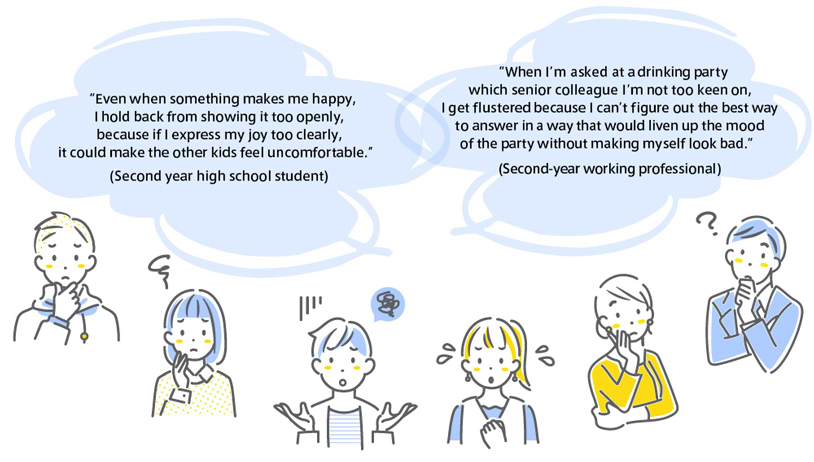
This suggests that even feelings of joy or dissatisfaction are adjusted with an awareness of the impact they may have on others. Today’s young people are living in an era where they are expected to be cautious about how they express their emotions.
“All-round consideration” is the norm in today’s world
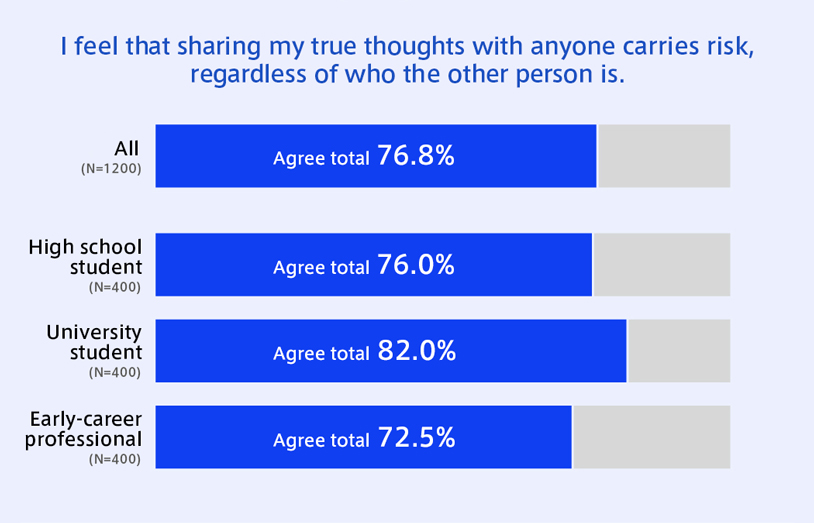
“I feel that sharing my true thoughts with anyone carries risk, regardless of who the other person is.” In this survey, 76.8% of all young people responded in this way. When people talk in this way they are referring not only to workplace managers and senior staff, but also to close friends and colleagues. For young people, speaking one’s true thoughts has become an “action requiring careful handling,” regardless of the closeness of the relationship.
So why has expressing one’s true feelings become such a cause for caution? In Dentsu Wakamon’s interviews with young people, we heard the following points of view.
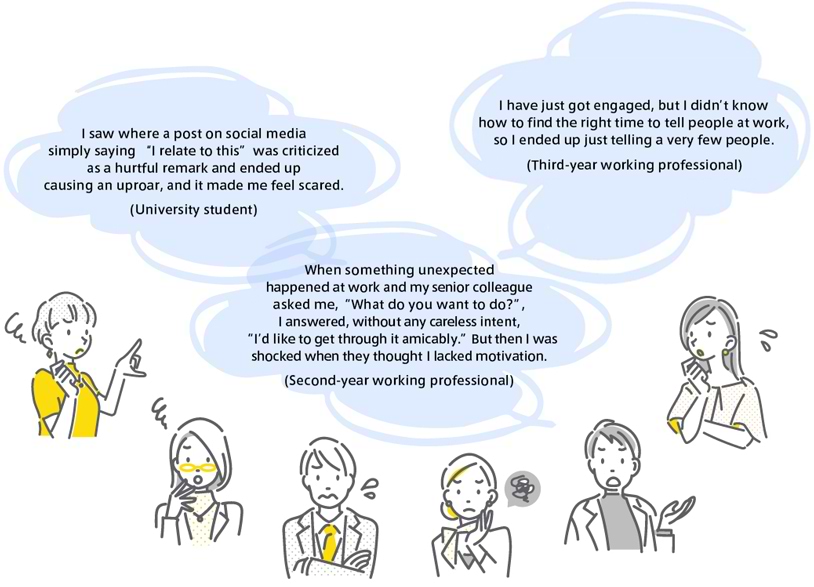
This shows the perception that today even happy news might make someone uncomfortable if enthusiasm is misgauged. Even positive emotions are difficult to express without some degree of concern.
Young people are acutely aware that casual everyday emotional expressions might:
“Touch upon a taboo subject for someone”
“Become a landmine that ruptures the atmosphere”
“Be misunderstood in a way different to the original intention.”
These perceptions are especially pronounced because social media platforms like SNS and LINE, or in other words places where “emotions become visible, spread, and get reinterpreted,” are a constant presence in daily life.
The environment young people now inhabit is one where “being mindful in any and all directions is the standard for good manners.” Dentsu Wakamon describes the thinking of young people living in such an era as “all-round consideration mindset.”
Speaking one’s true feelings might make someone uncomfortable. Or, if one is on the receiving end of someone else’s true feelings, one might end up becoming emotionally tangled in them. To avoid the emotional fatigue from such exchanges and minimize emotional burden, the inclination to avoid “emotional contamination” is now taking root as a fundamental behavioral value among young people.
Prioritization over “time performance”? Tendency to avoid “emotional contamination” is spreading into work attitudes and content consumption
“If it costs my peace of mind, then results or deliverables come second.” This is the way many young people today are thinking as they shift their value criteria for the way they work accordingly.
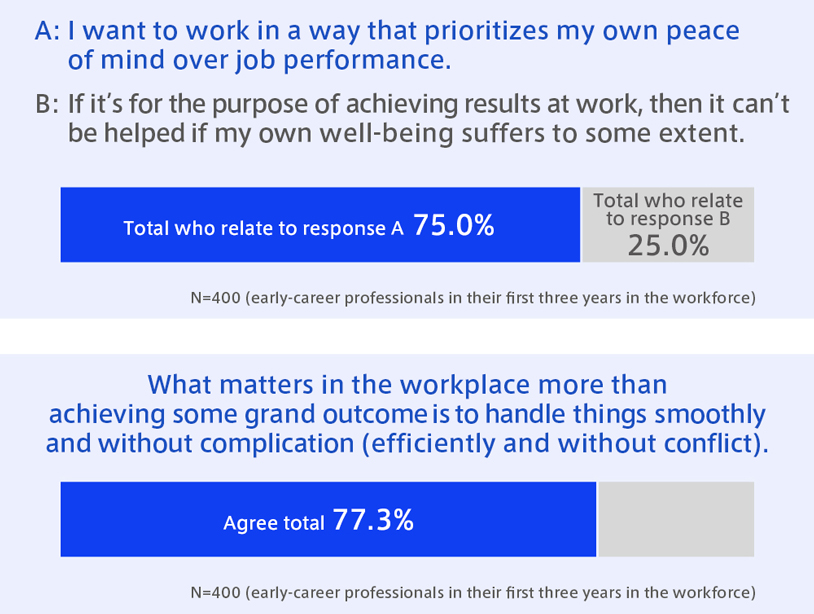
In our survey, 75.0% of early-career professionals responded that “ I want to work in a way that prioritizes my own peace of mind over job performance.” Furthermore, 77.3% answered that they consider “What matters in the workplace more than achieving some grand outcome is to handle things smoothly and without complication.” This suggests that in personal career development, what is being given first priority as a standard is to “not let one’s own well-being suffer.”
This tendency is even more pronounced in standards relating to selecting a job.
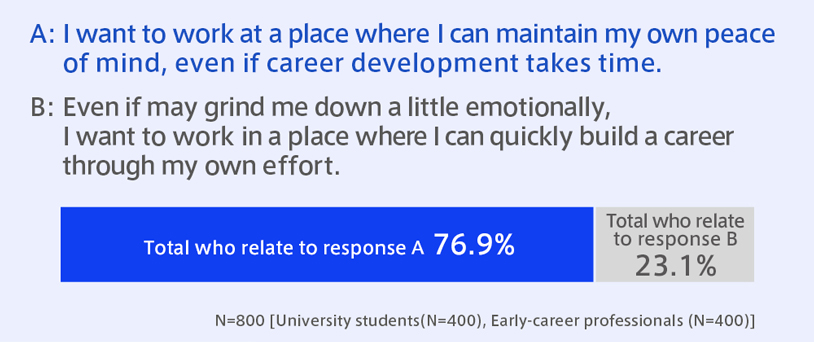
For example, in the survey 76.9% responded that they want to “work at a place where I can maintain my own peace of mind, even if career development takes time.” This is nearly the polar opposite of the “time performance” orientation once valued among young people. Instead of “wanting to grow quickly,” the mindset is now rather one of “wanting to continue without undue strain.” The sense of prioritizing emotional sustainability over time itself is shaping the way people approach work in this new era.
This value of seeking to avoid emotional contamination is also spreading to everyday content consumption.
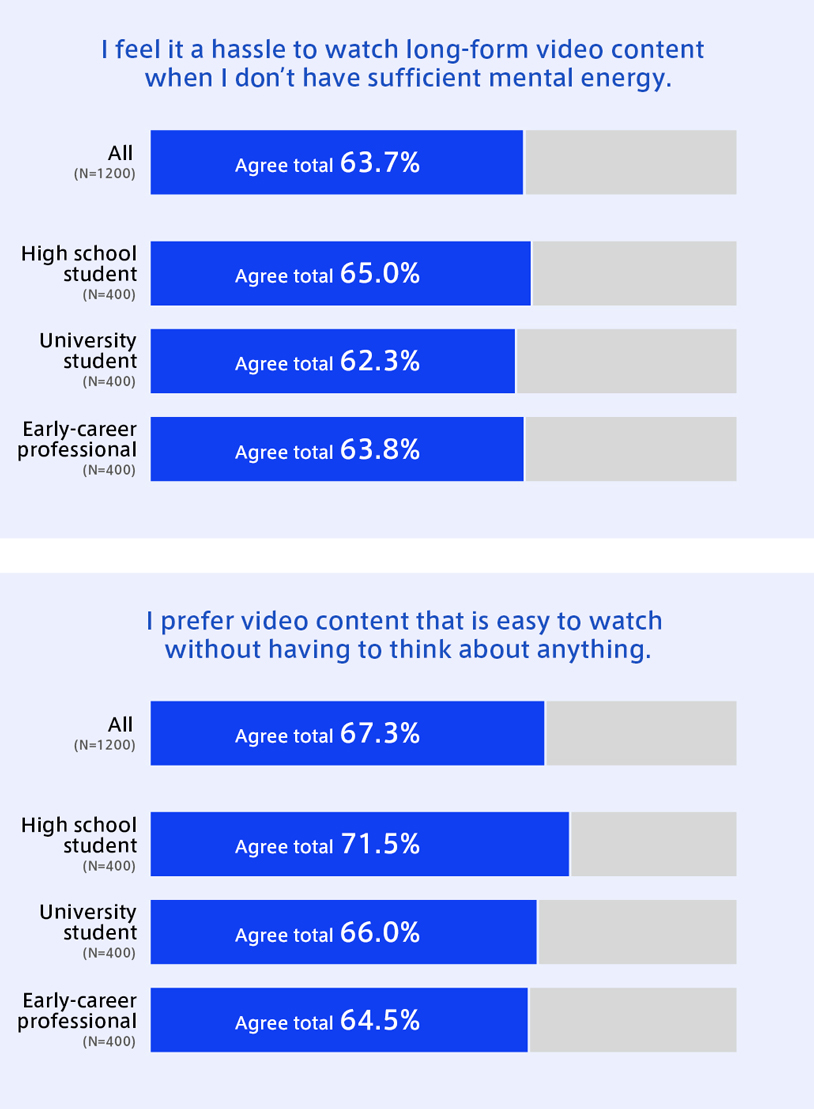
A total of 63.7% of young people surveyed responded that “I feel it a hassle to watch long-form video content when I don’t have sufficient mental energy.” 67.3% responded that “I prefer video content that is easy to watch without having to think about anything.” These responses are suggestive of an unconscious desire to choose things that require no thought, and in so doing avoid emotional contamination as much as possible.
The value placed on avoiding such emotional contamination (or minimizing emotional burdens as much as possible) is increasingly permeating the behavioral values of today’s younger generations, extending from attitudes to work and career planning to everyday choices in entertainment.
Signs of a return of humanity: Longing for relationships built on true feelings
As we have seen through the survey results, young people approach communication cautiously and view it as being fraught with risk. At the same time, however, it has also become clear that within them lies a strong yearning for human relationships where they can connect through true feelings.
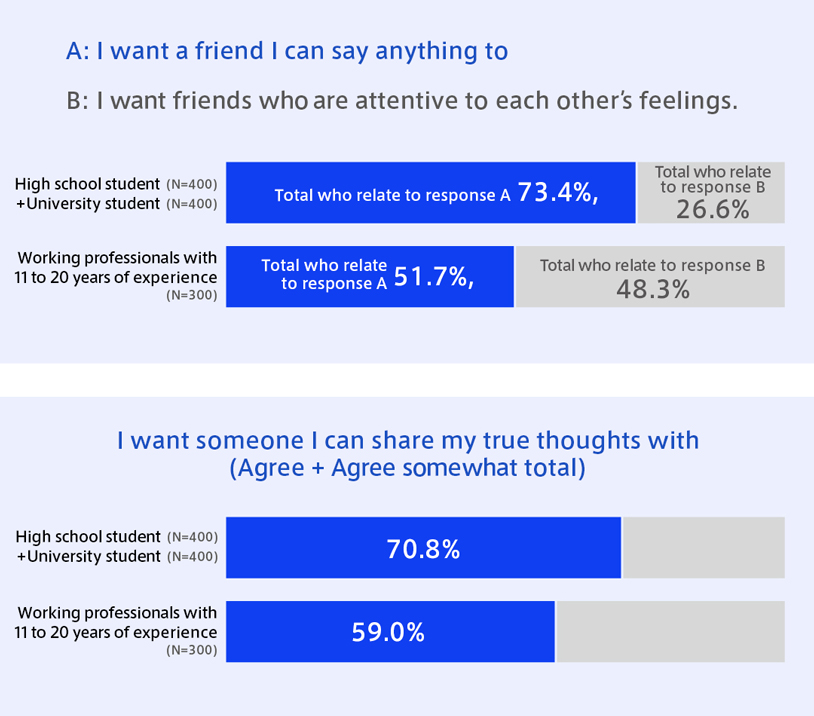
Statements like “I want a friend I can say anything to” or “I want someone I can share my true thoughts with” showed higher scores among young people compared to older adults. While young people may have become accustomed to holding back from sharing their true feelings, this is not necessarily what they desire. Rather, they appear to quietly harbor a sense of loneliness regarding the difficulty of creating relationships where they can be truly themselves, along with a yearning for a future where such relationships can be built.
This tendency also appears in more formal settings like the workplace.
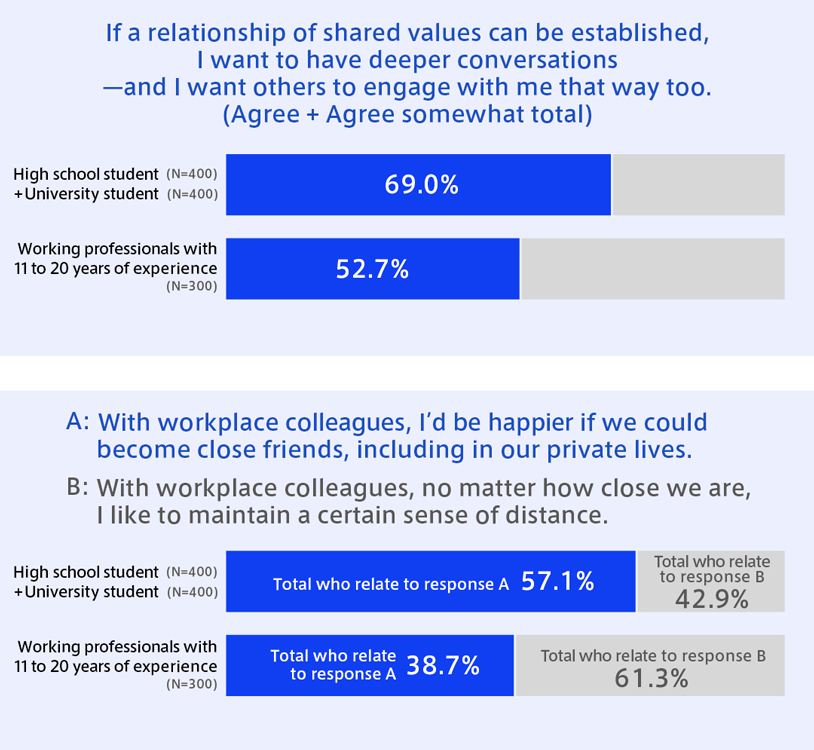
If good interpersonal relationships can be built, young people seem to want more meaningful conversations with their managers and senior colleagues. Many also hope for relationships where they become close even in their private lives. Precisely because keeping their distance is set as the baseline, meaningful exchanges of true feelings carry special value.
This longing for “deeply connected relationships” also finds a voice in an expression that is appearing increasingly on social media in recent years: “toutoi” (revered/precious). Relationships where people engage with each other based on their true feelings, such as friends who can say anything to each other or romantic partners who care for each other, are increasingly described as “toutoi,” which is an expression both admiration and emotional resonance. This can be understood as the rare desire for relationships built on true feelings, manifesting itself as a shared expression of the times we live in.
Dentsu Wakamon views this trend as “signs of a return to humanity.” Young people are not disenchanted with interpersonal connections; rather, they are cautious because they truly want to engage with others. What surfaced in this survey as young people’s true and authentic feelings is a quiet sign of return to humanity, namely, “I want to build relationships where we can truly trust and feel at one with each other.”
| Survey Overview | |
|---|---|
| Survey Name: | Young People Insights Survey |
| Survey Organization: | Dentsu Macromill Insight |
| Survey Timing: | December 2024 |
| Survey Method: | Internet-based survey |
| Survey Area: | Nationwide |
| Survey Target & Sample: | Unmarried men and women ages 15-46 (high school students and above) 2,000 persons (with equal gender distribution by segment) |
| Breakdown: | High school students: 400 persons; University students: 400 persons; Early-career professionals (1–3 years): 400 persons; Mid-career professionals (4–10 years): 500 persons; Experienced professionals (11–20 years): 300 persons |
| * | In extracting the above samples, a screening survey was conducted targeting general men and women ages 15-69 (high school students and above). From these results, 10,000 samples were extracted based on population composition ratios and used separately for analysis. |


